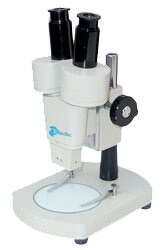
About Stereo Binocular Microscope
A Straight Binocular stereoscopic Microscope with simple base. Flat sharp image Erect and Unreserved .Wide Field eyepieces. Long working distance and large field of view. Direct measurement on specimens with optional eye pieces. Sturdy rack and Pinion for focusing. Packed in wooden box.
Objective fixed: 2x (W.D.90 mm, field ofview-9mm)
- Eye Pieces : WF 10x or WF 15x
- Magnification : 20x or 30x
Superior 3D Viewing with Achromatic OpticsThe stereo binocular microscope uses achromatic objectives and widefield eyepieces to deliver bright and clear 3D images. Its stereoscopic vision is ideal for routine inspections, biology studies, or electronics assembly, ensuring vibrant color fidelity and enhanced depth perception in every examination.
User-Centric Ergonomic DesignFeaturing a 45 inclined binocular head and adjustable interpupillary distance (55 75 mm), this microscope ensures stress-free viewing for extended periods. The 360 rotatable view head makes it convenient for multiple users, while diopter-adjustable eyepieces accommodate individual differences in vision.
Efficient Illumination and FocusingIncident (top) and transmitted (bottom) light sourcesselectable between LED and halogenoffer ample lighting for diverse specimens. The rack and pinion focusing system, equipped with tension adjustment, provides reliable coarse adjustments up to 50mm, while the frosted glass stage with clips keeps samples secure.
FAQs of Stereo Binocular Microscope:
Q: How does the stereo binocular microscope provide 3D visualization of specimens?
A: The stereo binocular microscope utilizes paired eyepieces and objectives to present slightly different perspectives to each eye. This setup creates a three-dimensional effect, allowing users to perceive depth and structure in the specimen during observation.
Q: What is the magnification range, and how is it achieved?
A: The microscope offers two primary magnification settings20x and 40xachieved through paired achromatic objectives (2x and 4x) combined with widefield 10x binocular eyepieces. Simply switch objectives to adjust between the magnifications as needed.
Q: When should I use incident and transmitted illumination?
A: Incident (top) illumination is ideal for opaque specimens, allowing light to bounce off the surface for clear observation. Transmitted (bottom) illumination is best for transparent or semi-transparent samples, as the light passes through the specimen to reveal internal details.
Q: Where is this microscope commonly used?
A: This stereo binocular microscope is widely used in educational settings, research labs, quality control departments, and industries for inspecting biological samples, circuit boards, gemstones, and small mechanical parts.
Q: What is the process for adjusting the focus and interpupillary distance?
A: Focusing is performed using the rack and pinion coarse adjustment knob, allowing movement up to 50mm. To align the eyepieces with your eyes, you can adjust the interpupillary distance between 55 mm and 75 mm, and fine-tune with diopter adjustments if necessary.
Q: How do I benefit from the 45 inclined and 360 rotatable view head?
A: The 45 inclined view head reduces neck strain during prolonged use, while the 360 rotatable feature facilitates easy collaboration and sample sharing between multiple users without moving the entire instrument.
Q: What spare parts are available and where can replacements be sourced?
A: Spare parts such as eyepieces, objectives, stage clips, and bulbs are available from the manufacturer or suppliers in India. Contact your exporter or supplier for genuine and compatible replacement components when needed.






 English
 Spanish
 French
 German
 Italian
 Chinese (Simplified)
 Japanese
 Korean
 Arabic
 Portuguese
 Send Inquiry
 Get Latest Price

