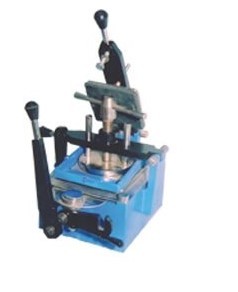
About Two Unit Isolated Organ Bath
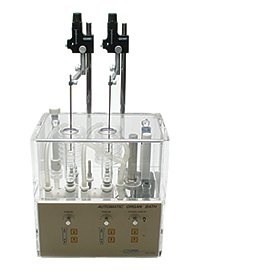
A Perspex organ bath with fine thermostatic temperature control: Electric Stirrer: and complete set of accessories, making it a versatile unit for all research work. Bath size 12 x9x 8 with leak proof dovetailed joints, resting in sturdy metal frame: top of the bath carries a 1 x 3/8 thick band, for fixing accessories .Inside the bath is a metal sheathed heating element(replaceable).controlled by means of a fine ,adjustable thermostat .Thermostat sensitivity C.
The Stirrer unit is completely independent, and dips in the bath and fixed in one corner.
A Perspex junction box is fitted to the bath frame, and carries all the electrical lead sand connections. Two pilot lamps indicate functioning of the thermostat and stirrer.
Standard Components are:
- Double set of glass inner Vessels.
- Oxygen tubes.
- Warming coils.
- Two Stainless steel capillary levers
- Four stainless steel uprights with boss heads.
- X Blocks
Precision for Parallel Organ StudiesThis two-chamber organ bath enables simultaneous experiments, improving efficiency and comparative analysis. Each chambers independent temperature control and fine aeration ensure optimal conditions for organ tissues. The double wall insulation and over-temperature protection maintain safety and thermal consistency.
Streamlined Features for Laboratory EaseEquipped with external water level indicators and a drain valve, the organ bath simplifies setup and cleaning. The analog thermometer and manometer provide real-time, accurate measurements, while the polished stainless steel chambers ensure durability and resistance to rust or chemical reactions.
FAQs of Two Unit Isolated Organ Bath:
Q: How does the heating mechanism of the Two Unit Isolated Organ Bath maintain temperature accuracy?
A: The organ bath uses an immersion-type heating element coupled with a thermostatic controller, achieving temperatures from ambient up to 60C with an accuracy of 0.5C. Double-wall insulation helps maintain thermal stability, and an over-temperature cut-off ensures safety.
Q: What organisms and tissue types are compatible with this organ bath model?
A: This equipment is designed for use with isolated organs such as frog or rat intestines, hearts, uteri, and other smooth muscle tissues, making it suitable for a wide range of pharmacology and physiology experiments.
Q: When should the water in the chambers be changed, and what is the process for emptying them?
A: It is recommended to change the water after each experimental session to avoid contamination and maintain accuracy. The built-in drain valve facilitates easy and hygienic emptying of the chambers without disrupting setup.
Q: Where is this organ bath most effectively used?
A: The organ bath is primarily designed for use in pharmacology and physiology laboratories, especially in academic or research institutions where experiments with isolated smooth muscles or organs are conducted.
Q: What are the benefits of having two chambers in this organ bath model?
A: Having two independently controlled chambers enables simultaneous, parallel experiments. This allows for direct comparison between samples or conditions, saving time and increasing experimental consistency and throughput.
Q: How is pressure measured during organ experiments?
A: Pressure is measured using an included manometer, which can be mercury- or water-based, providing analog readings to monitor and document changes due to muscle contractions or other physiological responses.
Q: What features support safe and efficient laboratory operation with this organ bath?
A: Key safety and operational features include an over-temperature protection cut-off, external water level indicators, rust-proof stainless steel construction, double-wall insulation, and a secure, table-top design. These elements minimize risks and simplify usage.





 English
 Spanish
 French
 German
 Italian
 Chinese (Simplified)
 Japanese
 Korean
 Arabic
 Portuguese
 Send Inquiry
 Get Latest Price

