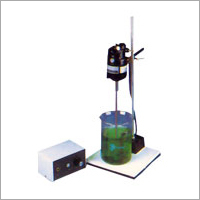
About Tissue Homogeniser
Heavy & stable cast iron base duly painted with mild steel chrome plated upright provided with strong adjustable clamps to hold motor with stirring rod of stainless steel with Ptfe grinder and clamp to hold tissue homogenizing vessel of borosilicate glass which is also adjustable. Speed variable through a control unit to work on 220V AC 50Hz single phase Motor used is of 1/20 H.P
Specification
- Homogenizing vessel 25 ml.
- Homogenizing vessel 50 ml.
- Homogenizing vessel 100 ml.
Efficient High-Speed HomogenizationThe TH-1101 tissue homogeniser offers rapid, consistent sample processing at speeds up to 20,000 RPM. With a mixing time of just 13 minutes, it delivers fast results essential for laboratory workflows. The manual operation provides flexibility to fine-tune homogenizing conditions for a variety of sample types.
Safe and Reliable Laboratory EquipmentSafety is prioritized with an integrated overload protection feature, ensuring both user and sample security during operation. The device is constructed from robust stainless steel and borosilicate glass, making it resistant to chemical corrosion and easy to sanitize between uses.
Versatile Compatibility and Simple OperationThis homogenizer is compatible with standard laboratory beakers, accommodating sample volumes from 10 to 100 ml. The analog display ensures straightforward monitoring, while the ergonomic design saves bench spacemaking the TH-1101 a user-friendly solution for many laboratory environments.
FAQs of Tissue Homogeniser:
Q: How do I operate the Tissue Homogeniser Model TH-1101 for optimal results?
A: To use the TH-1101, place your sample in a compatible standard laboratory beaker (10100 ml capacity), insert the homogenizing shaft, and set the desired speed using the variable speed controller. For best results, keep mixing times between 13 minutes, depending on sample consistency.
Q: What types of samples can be processed with this homogeniser, and in which research areas is it commonly used?
A: This homogeniser is suitable for processing biological, chemical, and pharmaceutical samples. It is frequently used for tissue disruption, cell lysis, and mixing in laboratories focused on sample preparation for research or quality control applications.
Q: When should overload protection be used, and how does it work?
A: Overload protection activates automatically when the motor detects excess load or resistance, helping to prevent damage to components and ensuring safe operation. There is no need for manual interventionsimply reduce the sample load or viscosity and restart the unit.
Q: Where can I use this equipment, and are there specific environmental requirements?
A: The TH-1101 homogeniser is designed for use in laboratory settings and requires a stable power supply (220240 V, 50 Hz) and ambient temperatures up to 40C. It fits easily on standard laboratory benches due to its compact size and can be used wherever small-scale sample homogenization is needed.
Q: What are the maintenance steps and cleaning process for the homogenizer?
A: After each use, disassemble the homogenizing shaft and vessel, and wash thoroughly with appropriate solvents compatible with stainless steel and borosilicate glass. Regular inspection for wear is recommended. The design allows for easy cleaning, minimizing contamination risks between samples.
Q: How does the analog display enhance the homogenization process?
A: The analog display offers clear, real-time feedback on homogenizing parameters, allowing users to adjust speed and monitor performance precisely throughout the process. This contributes to repeatable and accurate results for laboratory sample preparation.
Q: What benefits does the TH-1101 provide over traditional manual homogenization methods?
A: The TH-1101 significantly reduces sample processing time (13 minutes), ensures uniform results at high speeds (up to 20,000 RPM), and lowers the risk of contamination or manual error. Its easy-to-clean design and safety features further streamline laboratory workflows.





 English
 Spanish
 French
 German
 Italian
 Chinese (Simplified)
 Japanese
 Korean
 Arabic
 Portuguese
 Send Inquiry
 Get Latest Price