About Semi Auto Chemistry Analyzer
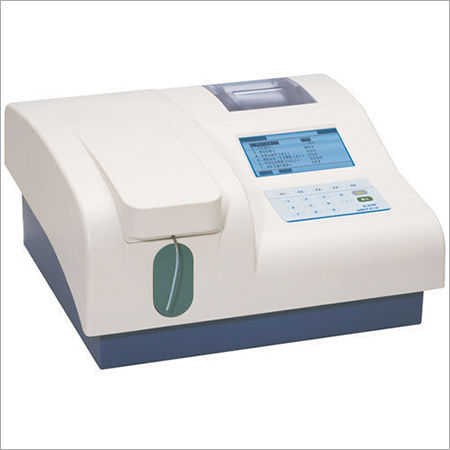
For Endpoint, Kinetic, Fixed Time, Multi Standard and Coagulation Tests. 100 open tests, dual Flow cell / Cuvette system with 18 l Flow cell. Built-in thermal printer with graphic capability. It has 28 quick access test keys, 40x4 character LCD display, Peltier controlled thermostat and user friendly software
Advanced Optical PrecisionUtilizing a halogen lamp (6V/10W) and direct-reading narrow band filters, this analyzer ensures dependable accuracy and wavelength specificity (2 nm), covering essential ranges for routine clinical tests. The system's design supports both standard flow-cell and disposable cuvette types, adapting to various laboratory preferences.
User-Friendly Operation & Versatile Data ManagementA large LCD and intuitive touch keypad streamline workflow. Over 10,000 results and 100 test programs can be stored with easy retrieval, while results are printed through a built-in thermal printer. Connectivity is robust, featuring RS232 and optional USB, and system software is updatable via USB.
Flexible and Reliable for Modern LabsBuilt from industrial-grade plastic, the bench-top unit is semi-automatic and designed for individual specimen analysis. Its stable performance across a wide temperature (10C-30C) and humidity range (10-90%) makes it ideal for hospital and diagnostic laboratories seeking accuracy, reliability, and efficiency.
FAQ's of Semi Auto Chemistry Analyzer:
Q: How does the Semi-Auto Chemistry Analyzer process individual samples?
A: The analyzer processes one specimen at a time through semi-automatic loading, using either a standard flow-cell or a disposable cuvette. The microcomputer-controlled system manages test sequences based on selected parameters, ensuring precise measurements for clinical biochemistry testing.
Q: What are the main benefits of using this chemistry analyzer in clinical environments?
A: This analyzer offers high photometric accuracy (0.01 Abs), rapid test speeds (up to 150 tests/hour), extensive data storage, and a user-friendly interface. Its robust construction and adjustable parameters make it suitable for diverse clinical applications, delivering reliable results for hospital and laboratory use.
Q: When should the software be updated, and how is it done?
A: Software updates are recommended whenever a new version is provided by the manufacturer. Updates are conveniently performed via the USB port, ensuring the latest features and security improvements are available to enhance operational performance.
Q: Where can this analyzer be installed, and what are its space requirements?
A: The compact tabletop design (dimensions 420 x 330 x 180 mm) allows easy installation in hospital laboratories, diagnostic centers, and research facilities. Its small footprint fits standard lab benches, making it ideal for various professional settings.
Q: What is the process for saving and retrieving test results?
A: Test results are automatically saved in the device's internal memory, capable of storing over 10,000 results. Retrieval is straightforward via the large LCD interface, and results can be directly printed using the built-in thermal printer for convenient recordkeeping.
Q: How is accuracy maintained during operation?
A: The analyzer is equipped with high-quality optical components, precise wavelength filters, and robust calibration protocols. The microcomputer automatically monitors the optical system and photometric performance, supporting consistent accuracy (0.01 Abs, 2% specification) throughout daily use.





 English
 Spanish
 French
 German
 Italian
 Chinese (Simplified)
 Japanese
 Korean
 Arabic
 Portuguese
 Send Inquiry
 Get Latest Price

