About Kjeldahl Unit
Made out of mild steel duly finished in white stoving enamel/powder coated paint with mat finished colour combinations other metallic parts are chrome plated. All following units are available without glass part:
KJELDHAL DIGESTION UNITS:
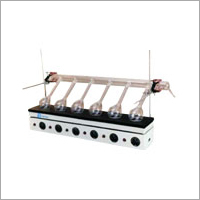
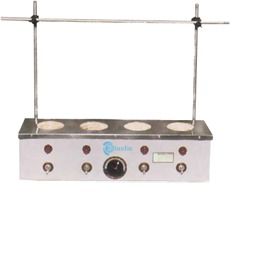
Useful for estimation of nitrogen contents in substance by digestion in 300 & 500 ml flasks. Provided with fume duct (optional) made of lead and pair of hangers. Workable on 220V AC 50Hz single phase. Individual on-off switches and one energy controller for all units is provided.
- Unit of 3 tests (Heater type)
- Unit of 6 tests (Heater type)
- Unit of 3 tests (Mantel type)
- Unit of 6 tests (Mantel type)
OPTIONAL:
- Fume duct made of lead or Borosilicate glass.
- Sunvic energy regulator.
KJELDHAL DISTILLATION UNITS:
Asbestos tops mounted on mild steel tubular stand. Provided with condenser clamps and water manifold. Other specification as above.
- Unit of 3 tests (Heater type)
- Unit of 6 tests (Heater type)
- Unit of 3 tests (Mantel type)
- Unit of 6 tests (Mantel type)
Efficient and Safe DigestionEquipped with intelligent temperature controls and a robust heating system, the Kjeldahl Unit streamlines sample digestion. Its comprehensive safety features, including fume ducts and shields, safeguard users from hazardous fumes and thermal exposure, making it ideal for daily laboratory routines.
Versatile Laboratory ApplicationsDesigned for diverse analytical needs, this unit is suitable for chemistry labs, food and feed analysis, as well as environmental and agricultural testing. Its adaptable sample capacity and customizable power supply make it an asset for institutions requiring precise nitrogen or protein determination.
FAQs of Kjeldahl Unit:
Q: How does the Kjeldahl Unit operate for nitrogen or protein determination?
A: The Kjeldahl Unit operates by digesting samples in heat-resistant glass tubes using controlled electric heating. The nitrogen content is converted to ammonia, which is then distilled and quantified, providing accurate measurements of nitrogen or protein in food, feed, or environmental samples.
Q: What configurations and sample capacities are available for the Kjeldahl Unit?
A: The Kjeldahl Unit is available in 3, 6, or 12 place models, accommodating various throughput requirements. It is designed to handle digestion flasks of 100ml, 300ml, or 500ml, catering to different sample sizes for a wide range of laboratory applications.
Q: When should safety features be engaged during operation?
A: Safety features such as the fume duct and safety shields should be used at all times during sample digestion and heating. These components protect operators from chemical fumes and accidental thermal exposure, ensuring a safe laboratory environment.
Q: Where is the Kjeldahl Unit commonly used?
A: This unit is widely employed in chemistry laboratories, food and feed analysis centers, and environmental or agricultural testing facilities across India and globally. Its versatility makes it suitable for educational, research, and industrial settings.
Q: What steps are involved in the Kjeldahl analysis process with this unit?
A: The process involves placing samples in digestion tubes, applying controlled heating for breakdown, distilling resulting ammonia, and then measuring it. This systematic approach yields precise nitrogen or protein content results as per the Kjeldahl method.
Q: How user-friendly is the Kjeldahl Unit for routine laboratory tasks?
A: With adjustable temperature controls, easy-to-clean glass assemblies, and straightforward sample loading, the Kjeldahl Unit is designed for efficient and user-friendly operation. Its robust construction and intuitive layout facilitate routine analyses.
Q: What advantages does this unit offer compared to traditional digestion systems?
A: The unit offers enhanced safety, efficient heating, and precise results through advanced temperature control and durable stainless steel construction. Quick assembly and cleaning further distinguish it from conventional systems, supporting high-throughput and accurate analysis.





 English
 Spanish
 French
 German
 Italian
 Chinese (Simplified)
 Japanese
 Korean
 Arabic
 Portuguese
 Send Inquiry
 Get Latest Price

