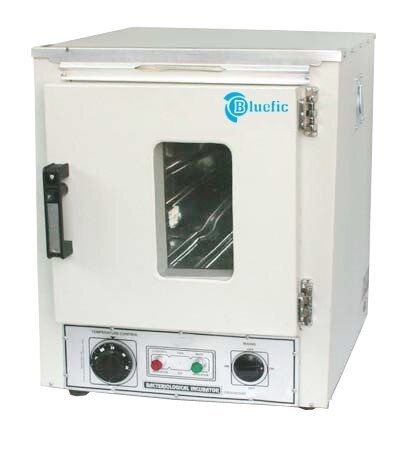
About Laboratory Egg Incubators
Outer wall is made of M.S. sheet duly finished in white stoving enamel/powder coated paint with mat finished color combinations and inside of stainless steel. The gap between inner and outer wall is filled with high grade mineral glass wool. Temperature range from ambient to 70 C is controlled by thermostat with an accuracy of 0.5 C. The unit is provided with manual tilting device, so as to tilt the tray holding the eggs. To work on 220/230 volts A.C. supply.
CAPACITY
- a)50 eggs.
- b)100 eggs.
- c)200 eggs.
- d)250 eggs.
Precise Environmental ControlAchieve optimal incubation conditions with advanced humidity and temperature management. The incubator supports a wide humidity range (40-90% RH) and maintains temperature uniformity within 1C, ideal for consistent results in laboratory egg hatching experiments.
Reliable Safety FeaturesEquipped with over-temperature and fuse protection, this incubator prioritizes user safety and specimen security. The digital temperature controller and programmable timer add layers of operational integrity for demanding laboratory protocols.
Effortless Monitoring and CleaningIntegrated interior lighting and a glass observation window enable easy monitoring of egg development without disturbing the chamber environment. The smooth anodized aluminum or stainless steel finish facilitates swift cleaning and reduces contamination risks.
FAQ's of Laboratory Egg Incubators:
Q: How does the Laboratory Egg Incubator maintain consistent temperature throughout the chamber?
A: The incubator uses a nichrome wire heating element and high-density PUF insulation for thermal stability. The digital controller ensures temperature accuracy within 1C, while natural air circulation distributes heat evenly across the chamber.
Q: What is the maximum egg capacity, and which types of eggs can be incubated?
A: The unit can hold up to 200 chicken eggs. While designed for laboratory egg hatching experiments, it is suitable for most eggs of similar size, including research or breeding projects involving other bird species.
Q: When should the humidity and temperature settings be adjusted during incubation?
A: Settings should be customized based on the type of eggs and their developmental stage. The programmable timer and digital controls allow users to modify humidity (40-90% RH) and temperature (ambient to 60C) as per incubation protocols.
Q: Where should the incubator be installed for optimal operation?
A: Install the incubator in a stable, power-supplied environment, such as a laboratory or research facility. Avoid placing it near direct sunlight, heat sources, or in locations with excessive dust for best performance and longevity.
Q: What are the benefits of the stainless steel or anodized aluminum tray material?
A: Both tray materials offer robust durability and resist corrosion. Their smooth surfaces make cleaning easy, reducing the risk of contamination and ensuring hygienic hatching conditions.
Q: How does the safety system protect eggs during incubator operation?
A: Over-temperature and fuse protection systems automatically interrupt operation if unsafe conditions are detected. This prevents accidental overheating and protects eggs and equipment from damage.
Q: What process should be followed for cleaning the inner chamber?
A: After removing eggs and disconnecting power, users should wipe the smooth anodized aluminum or stainless steel surfaces with a mild disinfectant. The seamless finish simplifies maintenance and supports rigorous laboratory hygiene protocols.





 English
 Spanish
 French
 German
 Italian
 Chinese (Simplified)
 Japanese
 Korean
 Arabic
 Portuguese
 Send Inquiry
 Get Latest Price