About Boerner Divider
Boerner Divider
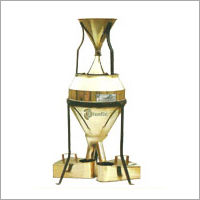
Borner Divider is gravity operated. Sample is Placed in the hopper and released by moving a slide gate located in the hopper throat.The products is evenly dispersed over acone that has 38 pockets. The grain after initial separation rejoins into two chuts which empty out of the bottom hopper.
Specification: Size 38 x 17 x 43(H x W x D)
- No. OF POCKETS 38
- HOPPER CAPACITY 1KG
- MATERIAL Body and inner parts are made of either copper or brass.
FEATURE
Provides Accurate splits of the grain samples with an accuracy of 1% on a 1kg sample. Boerner Divider is available in two different sizes.
Precision Sample Division for Laboratory ReliabilityEnsure replicable and representative analytical results by utilizing the Boerner Divider. Designed with 38 uniform slots and stainless steel collection pans, this device divides and mixes grain or seed samples with exceptional accuracy exceeding 99%. Its manual operation is straightforward, and the matte stainless steel finish offers easy cleaning and maintenance, ideal for laboratory settings.
Versatile Application for Grain and Seed TestingWidely used in seed testing laboratories and grain processing quality control, the Boerner Divider is acclaimed for its capability to create uniform, unbiased subsamples. Its ambient operating temperature, robust construction, and convenient dimensions (38 x 33 x 38 cm) make it suitable for frequent laboratory or industrial usage, supporting regulatory compliance and quality assurance protocols.
Superior Build with User-focused FeaturesMade with a durable mild steel body and equipped with stainless steel (SS) pans, the Boerner Divider guarantees lasting performance. The inclusion of removable pans, manual operation (no need for electricity), and a substantial measurement range (up to 100 grams) make it an indispensable tool for laboratories valuing both precision and usability.
FAQs of Boerner Divider:
Q: How does the Boerner Divider maintain sample accuracy during division?
A: The Boerner Divider uses 38 precisely engineered riffle compartments to evenly split seed or grain samples, ensuring each division is representative and achieves a splitting accuracy greater than 99%. Its design prevents cross-contamination and offers clean, unbiased sub-samples.
Q: What types of laboratories typically use the Boerner Divider?
A: This device is commonly deployed in seed testing laboratories and grain processing facilities for quality control, where consistent and reliable sub-samples are critical for subsequent analysis and testing.
Q: When should you use the Boerner Divider in the sample analysis process?
A: Use the Boerner Divider during the initial sample preparation phase to obtain smaller, representative portions from a larger bulk sample. This is essential before conducting any in-depth testing or analysis on seeds or grains.
Q: Where can the Boerner Divider be installed for optimal use?
A: The devices compact design (38 x 33 x 38 cm) allows for convenient placement on laboratory benches or workstations, typically in environments where ambient temperature conditions prevail and accessibility to manual equipment is required.
Q: What is the process for dividing samples with the Boerner Divider?
A: Place the bulk seed or grain sample into the top cone, ensuring it flows through the 38 slots. The sample is uniformly split into the two stainless steel pans provided, and any excess is caught in the removable overflow pan, ensuring convenient collection and minimal sample loss.
Q: How does the manual operation benefit laboratory workflows?
A: Manual operation removes dependency on power sources, provides direct user control over sample flow, and reduces maintenance needs by eliminating electrical components, making it especially valuable in laboratories seeking reliable, straightforward equipment.
Q: What are the benefits of the Boerner Dividers robust construction?
A: The mild steel body offers durability, while the stainless steel pans ensure easy cleaning and corrosion resistance, contributing to long-term reliability and maintaining sample integrity in demanding laboratory settings.





 English
 Spanish
 French
 German
 Italian
 Chinese (Simplified)
 Japanese
 Korean
 Arabic
 Portuguese
 Send Inquiry
 Get Latest Price

